Research

Seminars & Events

Music technology student

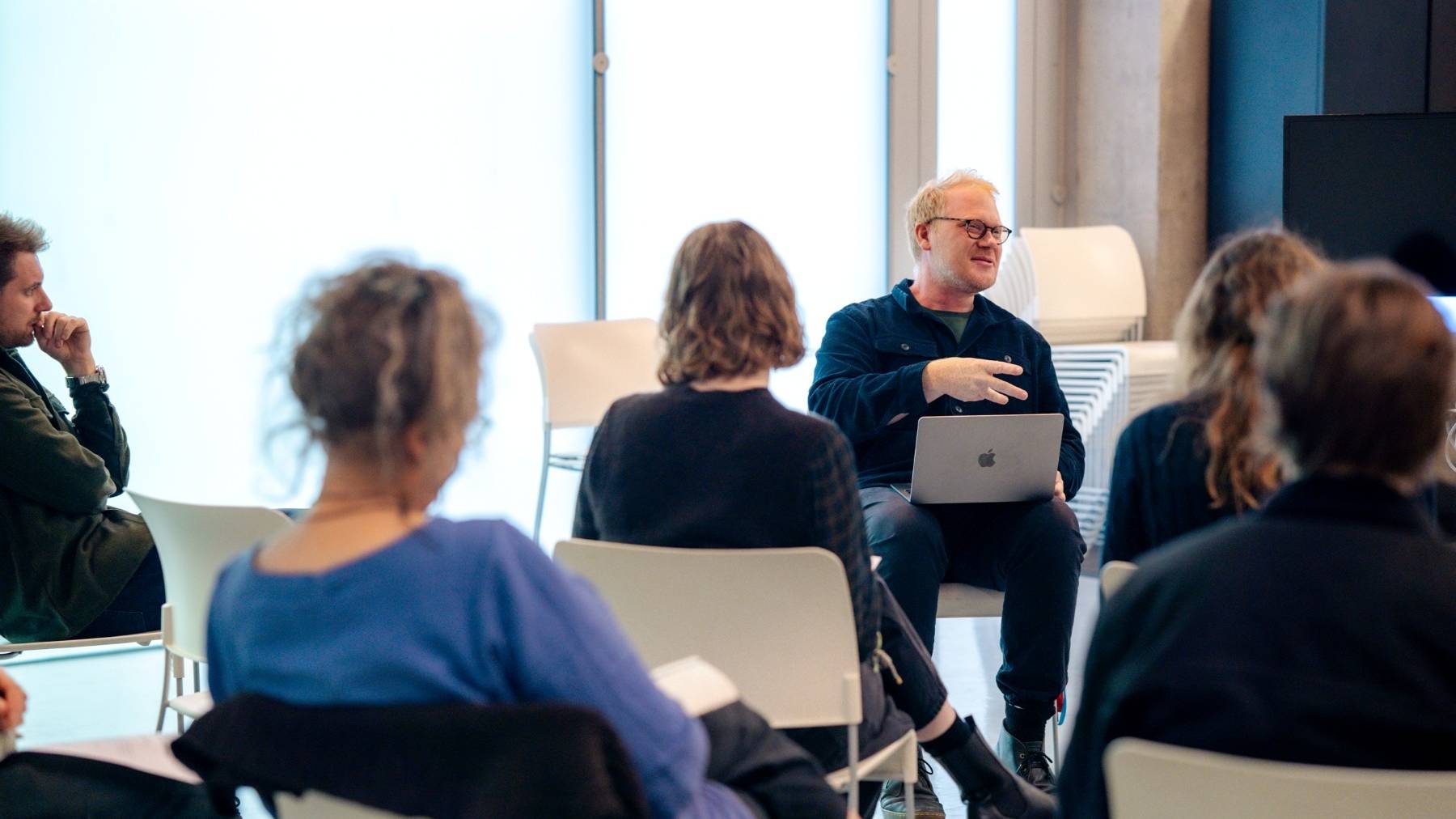
The Research Department regularly organises research seminars, symposia and other events. Please find below information on the current series of seminars as well as on recent and forthcoming conferences and events.


Research Seminars

The current series of research seminars runs from December 2011 to March 2012.

All seminars in this series, unless stated otherwise, take place in the Laban Lecture Theatre on Wednesdays from 16.15h-17.30h and are followed by an informal get-together in the Laban Bar. All welcome!

7 December 2011

Jonathan Clark (Head of Research, Trinity Laban)
Aesthetics, Voice, Historicity

The paper sketches a historiography of early music that aims to shed light on different problems in historicist theories arising in the contemporary philosophy of history (including the work of Michel Foucault and Frank Ankersmit), as well as the related historicism of the so-called 'New Musicology'. The presentation will contain an analysis of three episodes in early music history: Susan McClary's account of gender construction in the operas of Monteverdi; the role of the object-voice in Renaissance polyphony; and a revisiting and reworking of the 'harmonic cosmology' of Johannes Kepler.  In considering these examples, I aim to elucidate some aspects of the representational practices of the past (and of the present) that resist straightforwardly historicist readings. Central to this argument is a recognition that music, due to the triangulation and codetermination of subject/object/representation, is always already embedded in what Foucault called 'epistemic' formations, but that certain salient features of what music becomes via this embedding cannot be explained by the embedding alone. Most crucially, these features coincide with the musical consequences of the failure of discursive formations to account for their own generating principle.

8 February 2012

Imogen Walker (Dance Science Researcher and PhD Candidate, Trinity Laban)
Commitment, adherence and dropout among young talented dancers: A longitudinal, mixed methods investigation

Dance is a unique art form that involves movements of the body to communicate artistic intent. Dance can be both a challenging and rewarding vocation, and the pursuit of a career in this demanding art form often takes years of dedicated practice. Given the subjective (and competitive) nature of dance, no amount of training can guarantee a successful career. How does a young person in training remain committed and dedicated to his or her craft when the eventual outcome is so unknown? Why do some young people persist in dance while others withdraw? Findings will be presented that have begun to answer such questions.

The presentation will cover five studies conducted over the course of a three-year PhD investigating commitment, adherence and dropout among young talented dancers. These studies were part of a larger project on talent development working with the Centres for Advanced Training around England. The research into commitment, adherence and dropout employed a mixed methodology: quantitative data were generated regardingwhatthe young dancers were like, and qualitative data were gathered from the dancers' own words regardingwhythey committed to or withdrew from training. Findings synthesised from the five studies will be presented, and practical implications put forward.

22 February 2012

Gavin Morrison (Curator)
What w
e know of ignorance

Ignorance necessarily carries a pejorative sense. It is understood as being different from merely not-knowing in that there is a presumption of a normative state of that whichshouldbe known, thereby ignorance is the defective or incomplete form of that state. Ignorance can have a significant position within cultural power structures, whether it is the designation of that which is considered fundamental knowledge or a militant refusal to defer to standards of knowledge. This informs the possibility of creative practices to position themselves outside of the culturally implied standard of knowledge and allow for a possibility of different forms of understanding, questioning and articulation to emerge. This paper will consider creative methodologies that assume a position of informed ignorance and question the viability of this approach.

7 March 2012

Dominic Murcott (Head of Composition, Trinity Laban)
Conlon Nancarrow: an introduction to the composer and his lost percussion orchestra.

Conlon Nancarrow (1912-1987) is often described as the first digital composer due to the majority of his works being created for player piano by laboriously punching holes into rolls of paper, thus bypassing the limitations of human performance. Though relatively obscure in his lifetime he is now acknowledged as one of the twentieth century's great musical pioneers and his individual working methods produced a raft of new ideas that predate works of other more widely known composers. In commemoration of the centenary of Nancarrow's birth, Dominic Murcott is curating a Festival and Conference dedicated to his work at the Southbank Centre in April 1012. In advance of this event this paper will introduce Nancarrow's work and the author's exploration and interpretation of his early percussion/musique concrète experiments.

For information about the conference and festival please visit the following page: Nancarrow In The 21st Century.

21 March 2012

Patricia Holmes (Senior Lecturer, Trinity Laban)

The performer's experience: psychological, philosophical and educational perspective  (PhD by prior publication)

What is the relationship between the performer and the performance? This question lies at the heart of my research, and I have chosen to address it principally through dialogue with the performer. Music performance research is generally directed towards objectivity - that is, study of performance as a phenomenon that can be observed and measured. In contrast, I aim to explore the subjective reality of the performer.  Against this broad backdrop, the papers that constitute my published portfolio fall into three main categories - learning and memorisation (specifically the role of advanced technique and exceptional insight in these processes at elite level), the contribution of personal characteristics to the development of expertise, and the nature, function and significance of timbre in expressive music performance. Predominantly qualitative methodologies (specifically phenomenology) have enabled me to reveal some of the more interesting, esoteric and hitherto unknown aspects of the world of the performer. In analysing some of the more surprising data, I have been glad to take advantage of recent blurring of perceived lines of demarcation between disciplines and have drawn increasingly and productively on developments in sport, dance and the social sciences.

In this seminar I will place the submitted portfolio in the context of later relevant research and also reflect upon the clear resonances with modern philosophical thinking that emerged from my studies.

2 May 2012

Kathy Dyson (jazz guitarist and composer)

17.15h-18.30h, Room 157, Faculty of Music at King Charles Court

Jazz, Music and the Brain: theoretical and practical possibilities for enhancing performance, practice and teaching approaches in jazz, from a musician's perspective 


Scientific knowledge and research into music and the brain and how one affects and interacts with the other, continue to grow apace. Much of the research is highly specific and generally tends to be disseminated amongst experts and in academic journals, or is oversimplified by the press.

So, what is the current thinking about how music affects the brain and how the brain is organised through listening to and performing music? How can the jazz musician and educator use this knowledge to better understand and to enhance their creative, learning, performing and teaching processes?

This lecture aims to cover three areas, from a musician's perspective: 

- To provide a clear and intelligible summary overview of brain anatomy and function (in as far as it is known) related to the learning and performing of music and a brief review of the latest relevant research in the field. 

- To describe a theoretical model based on the above, about how jazz improvisation may be learned and performed from a neuro/cognitive perspective, based on schema theory.

- To suggest how it may be possible to integrate ideas and insights from both areas into daily practice and teaching approaches. 


Recent Events


Nancarrow in the 21st Century
21 and 22 April 2012
Southbank Centre / Trinity Laban Conservatoire of Music and Dance
London UK

To mark the centenary of Conlon Nancarrow's birth, Trinity Laban Conservatoire of Music and Dance hosted a conference at London's Southbank Centre to coincide with Perfect Constructions: The Music of Conlon Nancarrow, a two-day festival. The theme of the conference was the exploration of contemporary practice and thinking in relation to Nancarrow's original ideas.

For details please visit the conference website.


Without Warning

31 January to 11 February 2012

Without Warning is a piece of contemporary live theatre combining dance and live music inspired by Brian Keenan's compelling account of four and a half years in captivity.Following sell-out premier performances at Laban Theatre in November 2010, Without Warning Company is re-siting the work for two weeks at the Old Vic Tunnels. Read more about Without Warning.


Symposium: Passion, Pathways and Potential in Dance

A symposium in October 2011 presented the findings of a major national research project into dance talent development

Are you interested in training the dancers of tomorrow? Do you want to know more about dance talent development? Read more about Symposium: Passion, Pathways and Potential in Dance.


Research Student Showcase

PARALLAX 01

April 2011 saw the first in a new series of annual events curated by and showcasing the work of Research Degree Programme Creative Practice students:

Performances, installations and an open discussion. Read more about PARALLAX 01.

PARALLAX 02 is planned to take place in September 2012.