
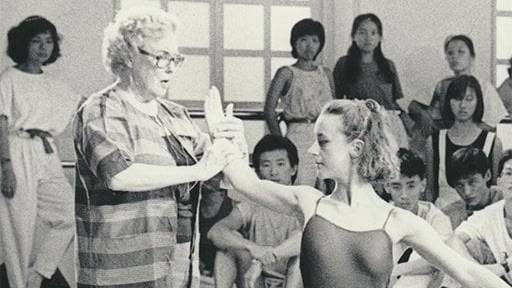
Bonnie Bird
If you step inside the Bonnie Bird Theatre at Laban Building, you’ll see the following dedication on its wall:
This theatre space celebrates Bonnie Bird; pioneer, educator and dancer whose spirit animates the commitment to developing dance artists of the future.
From establishing Britain’s first BA (Hons) Degree in Dance Theatre studies at Trinity Laban to bringing together Merce Cunningham and John Cage, Bonnie Bird was central to shaping the world of contemporary dance.
Born in Portland, Oregon, Bonnie studied at the Cornish School of Fine Arts (now Cornish College of the Arts) in Seattle. During her time at the school, Head of the Dance Department Nellie Cornish brought in world-renowned dancer Martha Graham to teach a summer intensive course. Martha invited Bonnie to join the Martha Graham Dance Company as one of its original members. Following on from this collaboration, Bonnie soon became Martha’s principal assistant and one of the first recognised teachers of the Graham technique.
In autumn 1937, she returned to the Cornish School as Head of the Dance Department. It was here that she encouraged Merce Cunningham to switch from theatre to dance and hired John Cage as accompanist-composer. Bonnie also trained several dance luminaries, including Syvilla Fort.
Moving to the Young Men’s and Young Women’s Hebrew Association (now 92nd Street Y, New York), she then worked on developing a dance programme for young people with Doris Humphrey. At the YM-YMHA, she established the Merry-Go-Rounders, a highly successful company that presented dance for children. During her years in New York, Bonnie also worked with the Dance Notation Bureau and was a founding member and president of the American Dance Guild and the Congress on Research and Dance.
Bonnie’s work with Labanotation at the Dance Notation Bureau led her to request a visit by Marion North of the Laban Art of Movement Studio (now Trinity Laban). The two formed an instant and lasting friendship. In 1973, Bonnie was invited to become principal lecturer at the Laban Centre, developing a dance theatre department. In 1977-78, the Council for National Academic Awards (CNAA) validated the first British Dance Theatre Bachelor of Arts degree developed under the leadership of Bonnie and Marion. This was followed by pioneering MA and PhD degrees in Dance Studies.
Alongside these newly established courses, Bonnie Bird proposed the foundation of a postgraduate course for dancers who had already completed a minimum of three years full-time professional training. The Dance Performance Course was thus set in motion and Transitions Dance Company was born.
Acting as a bridge between training and the dance profession, Transitions Dance Company (now Trinity Laban Dance Collective) is still going strong forty three years later. As Britain’s foremost professional training company for young dancers, Trinity Laban Dance Collective underlines Bonnie Bird’s fundamental philosophy for dance: the equal importance of both practical and theoretical elements in the training of the professional dancer.
Furthering this foundational work, Bonnie used donations from friends and colleagues for her 70th birthday to establish the Bonnie Bird Choreography Fund. The Fund aims to encourage the development of choreographers and dance writers in the early stages of their careers. It has influenced many internationally renowned choreographers, including Lea Anderson, Matthew Bourne, and Rosemary Lee.
Bonnie Bird officially retired in 1989. A year later, the CNAA awarded her a Doctor of Arts degree, honoris causa, for her pioneering work on dance programmes in the UK. She remained Artistic Director of the Laban Dance Centre until her death in 1995.
At the opening of Laban Building in 2002, the main 300-seat performance venue was named after Bonne Bird. Today, the Bonne Bird Theatre stands as a tribute to her legacy – a stage where the creative pioneers of Trinity Laban perform each term and step into the spotlight.
Bonnie Bird (1914 – 1995) was a member of the original Martha Graham Dance Company. She went on to become Graham’s principal assistant and one of the first recognised teachers of the Graham technique. After this she joined the Cornish School of the Arts in Seattle, at that time one of the most innovative institutions in the USA, as its Head of Dance. There she trained numerous people who became luminaries in dance, her most famous student being Merce Cunningham. In 1938 she married the eminent psychologist Ralph Gundlach.
After the war Bonnie Bird pursued her dual involvement in developing contemporary dance through university dance college programmes and community arts centres. She was a founder member and a president of the American Dance Guild, as well as The Congress on Research in Dance (CORD). All this underlines Bonnie Bird’s fundamental philosophy for dance, in which she stresses the equal importance of the practical and theoretical elements for the training of the professional dancer.
In 1974, at the age at which most people retire, she was invited by Marion North, Principal of Laban, to become Director of the Dance Theatre Department. Here she was able to apply and develop her theories on dance training by helping to institute Britain’s first BA (Hons) degree in Dance Theatre studies, and subsequently Britain’s first MA and PhD degrees in Dance Studies. In 1982 Bonnie Bird founded Transitions Dance Company, Britain’s foremost professional training company for young dancers. She remained Artistic Director until her death in 1995.

Interested in Studying Dance?
Explore our courses and programmes for undergraduate, postgraduate, or research.