
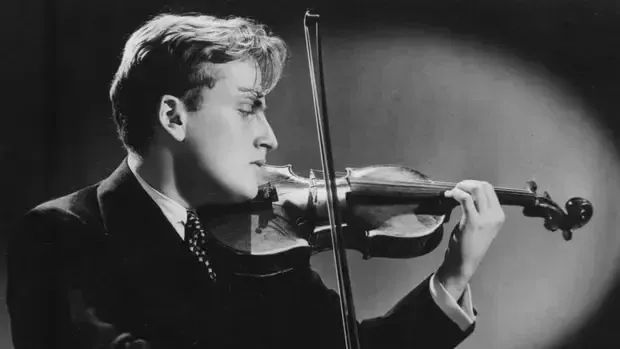
Yehudi Menuhin
A Centenary Message for Trinity College of Music from our President Yehudi Menuhin
It is a matter of some satisfaction that a music teaching institution is celebrating one hundred years of work and achievement in a world that is changing so rapidly, and in a field which has become so much more complex than would have been dreamt of even fifty years ago.
In music as much as in any other human activity the diversification and multiplication of knowledge has taken place at an unprecedented rate, so much so that comparative studies are as important as the intrinsic, basic studies, which were the rule until so recently. To have kept abreast of these developments and to have met the incessant challenges day by day is a measure of the ability and the imagination which mark this great College of Music.
It is with a feeling of undeserved pride that I welcome my association with Trinity College on the auspicious occasion of its Centenary.
14th February 1972.
Signed Yehudi Menuhin.
The Jerwood Library archive contains copies of the Trinity College of Music Bulletin, a journal published from 1966 to 1989. Its centenary edition in 1972 leads with the above message from legendary violinist and Honorary President Sir Yehudi Menuhin.
Over fifty years later, Menuhin’s message still resonates. In an age of constant transformation, Trinity Laban continues to reframe tradition and redefine artistic excellence, building on Honorary President Sir Yehudi Menuhin’s enduring commitment to creative education.
Born in 1916, Yehudi Menuhin was an internationally acclaimed child prodigy and one of the greatest violinists of the twentieth century. He started learning the violin at the age of four and performed as a soloist with the San Francisco Symphony Orchestra at just seven years old. This marked the beginning of an extraordinary career that would see Menuhin perform internationally with the world’s greatest orchestras.
In 1929, Menuhin made his London debut with the London Symphony Orchestra (LSO), and created his first recordings with EMI Records – a collaboration which lasted 70 years, the longest recording contract in history. Menuhin recorded Elgar’s Violin Concerto in 1932, returning to perform with the LSO under the baton of the composer himself. During his first global concert tour three years later, he made 110 appearances in 63 cities of 13 countries.
Beyond his exceptional musical talent, Menuhin was an unwavering advocate for human rights. During World War II, he gave hundreds of benefit concerts, including for the Red Cross and American and Allied troops in combat zones. Among the countless awards and distinctions he received are the French Legion of Honour, the Croix de Lorraine, the Royal Philharmonic Society’s Gold Medal, and an Honorary Knighthood. After the war, he performed to Holocaust survivors from liberated concentration camps in Germany with Benjamin Britten. In 1969, Menuhin was unanimously elected as President of the International Music Council of UNESCO and was re-elected several times.
The violinist’s expansive musical repertoire ranged from Bach’s Violin Concerto to especially commissioned Sonata for Solo Violin by Béla Bartók, an album with Indian sitar virtuoso Ravi Shankar, and duets with jazz violinist Stéphane Grappelli. He was also an acclaimed conductor, leading the world’s most prestigious orchestras and becoming the English Symphony Orchestra’s Principal Guest Conductor in 1991.
Menuhin’s steadfast commitment to music education led him to establish several schools, including the Yehudi Menuhin School for Music in Surrey. He helped to establish music festivals, including the Gstaad Saanenland Summer Music Festival, and also founded the charity Live Music Now! (LMN) to create inclusive, measurable social impact through music. The International Yehudi Menuhin Foundation continues to advance the musician’s humanist vision, using the arts to positively transform society.
Menuhin continued to perform and engage in humanitarian efforts until his death in 1999. His cultural, musical, educational, and humanitarian legacy lives on – Menuhin’s vision of music as a unifying force continues to shape the artistic world today.

Interested in Studying Music?
Explore our courses and programmes for undergraduate, postgraduate, or research.