
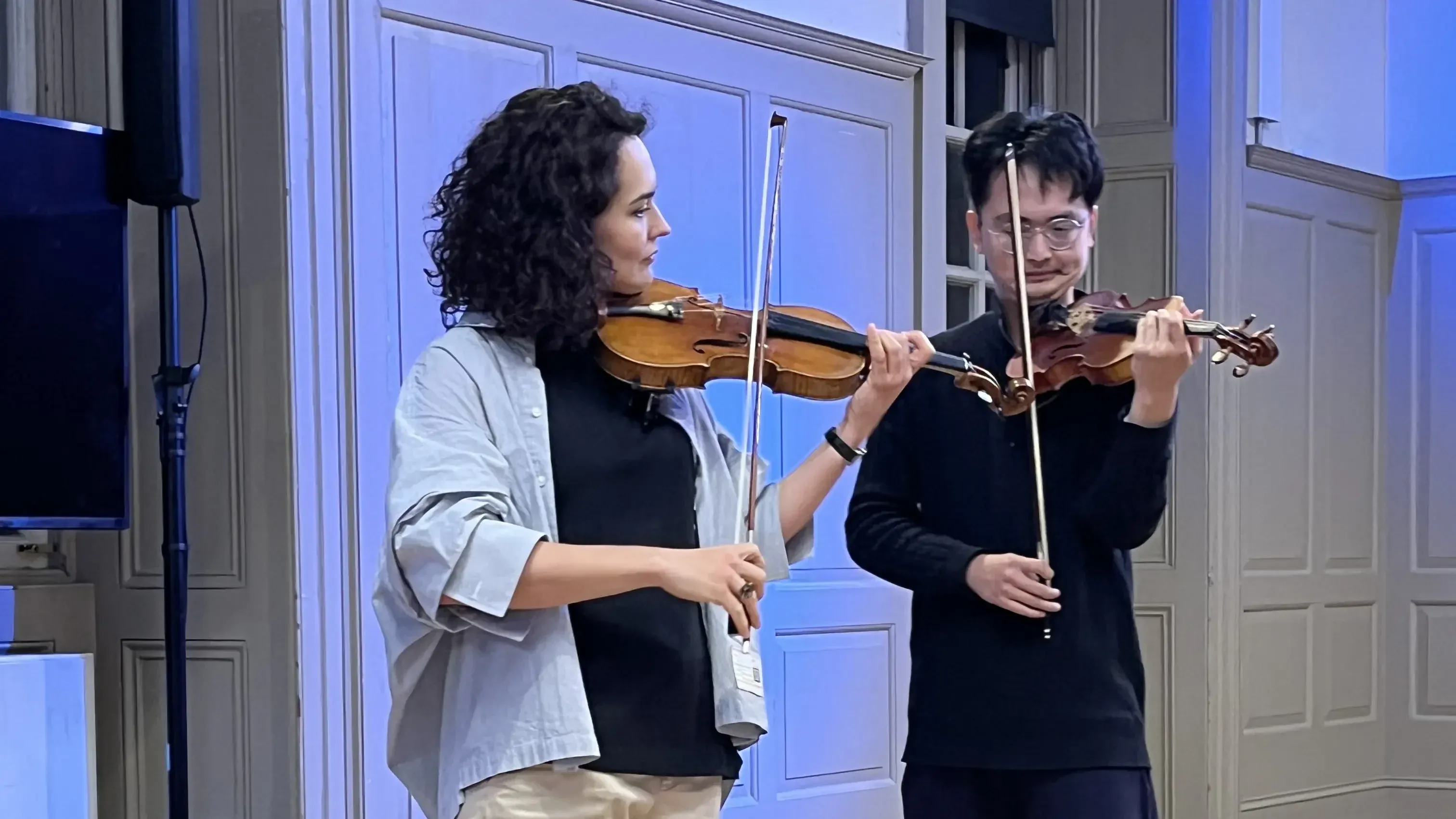
This October, Trinity Laban welcomed celebrated violinist Alena Baeva for a masterclass with our strings students.
The programme included wonderful performances of Brahms, Beethoven, and Ysaÿe from violinists Rongsi Hu, Sofiia Yavorska, Jiyun Zhang, and Nika Ulbl.
Trinity Laban Head of Strings Nic Pendlebury commented: “We were honoured to have Alena Baeva with us at Trinity Laban for the violin masterclass. It was a wonderful evening of engaging performances from some of our violin students of Brahms, Ysaÿe and Beethoven. Alena gave an inspirational and insightful class which the students responded to very positively. We are grateful that Alena could share her experience and expertise with students at Trinity Laban.”
About Alena Baeva
Described as “a magnetic presence” (New York Classical Review), violinist Alena Baeva is considered one of the most versatile and captivating soloists active on the world stage today. Possessing a passionate musical curiosity, Baeva holds a vast active repertoire: she is a champion of lesser-known works alongside the more mainstream violin literature, including such composers as Bacewicz, Karaev, Karłowicz and Silvestrov.
As an international soloist, Baeva has performed with orchestras including New York Philharmonic Orchestra, London Philharmonic Orchestra, NHK Symphony and Tokyo Metropolitan Symphony orchestras. Highlights of this season include The Royal Concertgebouw Orchestra, Philharmonia Orchestra, Die Deutsche Kammerphilharmonie Bremen, among others. Chamber music holds a particularly special place in Baeva’s musical life, and she enjoys collaborations with such artists as Yuri Bashmet, Daishin Kashimoto, and Misha Maisky. Her regular duo partner is Ukrainian pianist Vadym Kholodenko, and this season will perform at Wigmore Hall, Athens’s Megaron and Amici della Musica in Florence. Baeva records for the Alpha Classics label: her upcoming album is Vol.1 of the integral cycle of Beethoven violin sonatas, recorded with Vadym Kholodenko. Her previous release Fantasy (Alpha, 2024) was praised by Gramophone as “an intriguing sequence where each work benefits from illumination by its programme neighbours” and features works by Schubert, Stravinsky, Schumann and Messiaen, recorded with Vadym Kholodenko.