
The Hearing Maternity Project
Principal Investigator: Dr Michelle Meinhart
Hearing Maternity aims to establish music and motherhood studies as a new interdisciplinary field by exploring how music shapes and reflects maternal experience, developing new feminist and intersectional research methods, and building an international collaborative network that will produce lasting scholarly resources and future research.
Nine scholars from diverse backgrounds define key questions, frameworks and methods for studying music and motherhood, shaping future research and revealing how music gives form to maternal experience and cultural life.
At a time when motherhood is increasingly visible in the media and political discourse, this project brings these conversations together to ask what insights emerge when we study music through the lens of motherhood – and what music studies can contribute to understanding motherhood, mothering and reproductive justice. The project will lay the foundations for this new interdisciplinary field through a two-day international workshop at Trinity Laban Conservatoire of Music and Dance in July 2026. Drawing on feminist traditions of collaboration and collective authorship, nine scholars from diverse backgrounds will define key questions, frameworks and methods for studying music and motherhood, shaping future research and revealing how music gives form to maternal experience and cultural life.


Workshops & themes
The Hearing Maternity workshops explore how music actively shapes experiences of motherhood, rather than simply reflecting them.
Bringing together ideas from motherhood studies, feminist musicology, Black feminist thought, and reproductive justice, participants will examine how music influences the ways motherhood is understood, experienced and represented across different cultures and contexts.
The workshop centres on six interconnected themes:
-
Activism – exploring music’s role in reproductive justice, maternal activism and social movements.
-
Experience – examining pregnancy, birth, caregiving, loss and maternal identity through sound, voice, listening and memory.
-
Everyday life – considering how music supports care, community and wellbeing in domestic, educational and therapeutic settings.
-
Representations – analysing how mothers are portrayed, idealised, marginalised or reimagined across musical genres and media.
-
Mothers as musicians – investigating the structural barriers, inequalities and expectations affecting musicians who are mothers.
-
Creative practice – exploring mothering as a creative process and a form of knowledge that shapes musical composition and performance.
Throughout the workshop, participants will develop new approaches for studying music as evidence of maternal life, including performances, recordings, archives, playlists and everyday soundscapes. Particular attention will be paid to silences, absences and overlooked voices, alongside the ethical challenges of researching historically marginalised experiences.
The two-day programme combines shared readings, discussion of a draft Handbook of Music and Motherhood Studies, participant position papers, and collaborative reflection. Rather than simply presenting research, the workshop is designed to identify key questions, refine emerging ideas, establish future collaborations and lay the foundations for an international field of Music and Motherhood Studies.
Funding & support
The Hearing Maternity project and workshops have been made possible by a British Academy/Leverhulme Small Research Grant, with support from the Research and Knowledge Exchange Department at Trinity Laban. The scheme supports clearly defined primary research projects in the humanities and social sciences, meeting direct research costs and enabling activities such as collaborative workshops, conferences, archival research and visits involving research partners. By supporting focused projects with identifiable outcomes, it enables researchers to develop new ideas, strengthen scholarly networks and advance original research.
Running from May 2026 to April 2027, Hearing Maternity reflects these aims by bringing together an international group of scholars to establish new interdisciplinary connections between music studies, motherhood studies and reproductive justice. The London workshop forms the centrepiece of the project, providing a foundation for the proposed Handbook of Music and Motherhood Studies, future collaborations and the continued development of this emerging field.
Workshop co-leaders & participants
Co-investigators

Dr Michelle Meinhart (she/her/hers) – Reader in Musicology and Cultural History; Programme Leader: MMus and Diplomas, Trinity Laban Conservatoire of Music and Dance (Project Principal Investigator).
Leads the Hearing Maternity project, researching how music represents and shapes motherhood, care and maternal experience, and spearheading the development of Music and Motherhood Studies.

Professor Christina Baade (she/her/hers) – Professor and Chair, Department of Communication Studies and Media Arts, McMaster University (International Co-Investigator).
Explores music, media and gender, with current research examining how caregiving and motherhood shape the careers and creative lives of musicians.
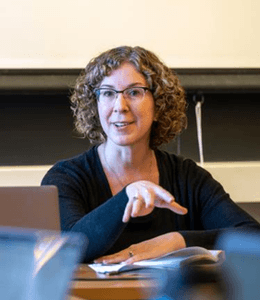
Dr Karen Leistra-Jones (she/her/hers) – Associate Professor of Music, Franklin & Marshall College (International Co-Investigator).
Researches lullabies and musical caregiving, exploring how they express maternal experience, identity and care across historical and contemporary contexts.
Participants
Dr Erin Johnson-Williams (she/her/hers) – Associate Professor of Music Education and Social Justice, University of Southampton (Handbook Co-editor).
Investigates music, maternity, decolonisation and social justice, examining how maternal perspectives reshape understandings of music history.
Dr Laura Watson (she/her/hers) – Associate Professor of Music, Maynooth University.
Explores the relationship between music, feminist activism and reproductive rights, drawing on research into Ireland’s Repeal movement and reproductive justice.
Dr Maria Ryan (she/her/hers) – Assistant Professor of Musicology, Florida State University.
Brings Black feminist perspectives to the project, examining music, slavery and reproductive justice through the lens of racialised maternal experience.
Dr L. Gre (they/them) – Lecturer in Music and Art & Media Technology, University of Southampton.
Uses collaborative sound practice to investigate gynaecological racism and develops creative methods that centre marginalised voices and lived experiences.
Professor Roe-min Kok (she/her/hers)– Professor in Music Research, McGill University.
Researches motherhood and family in nineteenth-century music, particularly through the lives and works of Clara Schumann and other women musicians.
Professor Charity Marsh (she/her/hers)– Professor and Head of Creative Technologies and Design, University of Regina.
Explores gender, music industries and feminist community-building, focusing on how creative practice can challenge inequalities in music and sound cultures.
Professor Christina Scharff (she/her/hers)– Professor of Culture and Subjectivity, King’s College London.
Researches gender, labour and feminism, providing expertise on the structural inequalities that shape creative careers and cultural work.
Professor Jacqueline Warwick (she/her/hers)– Professor of Musicology and Gender and Women’s Studies, Dalhousie University.
Studies gender, identity and popular music, bringing expertise in feminist musicology and facilitating the workshop’s cross-theme discussions.