
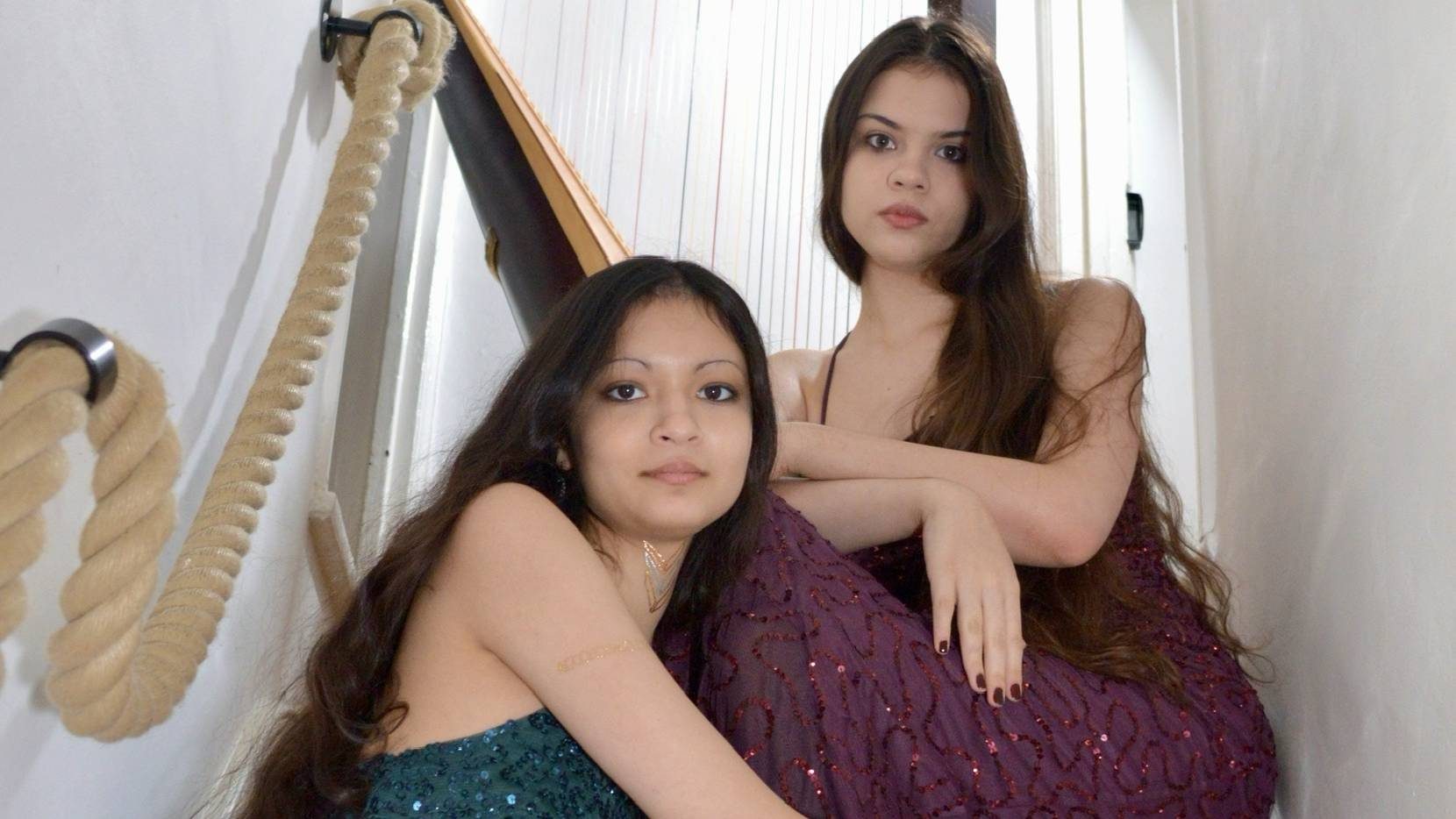
Catherine and Elizabeth Rajhans on versatile musicianship and the best harp concertos
Born in Kyiv, Catherine and Elizabeth Rajhans began learning the harp at the age of five. Studying at the Shamo Music School in Kyiv with Yelizaveta Herasina, they later continued their studies at the Chopin Music School in Moscow with Lena Watson. After participating and receiving nominations in several international competitions, they returned to Kyiv and completed their Music A Level through Junior Trinity. From performing at London Fashion Week in 2023 to giving several harp recitals across the UK, Catherine and Elizabeth are accomplished soloists and orchestral musicians, receiving scholarships from Trinity College London and the Richard Harrison Trust, as well as winning the John Marson Harp Prize for Outstanding Musicianship. We spoke to them about their experience of Junior Trinity, as well as their favourite conservatoire modules and compositions.
You both studied A Level Music at Junior Trinity. How did you find the course, and what were the highlights?
When our father was working in Italy, he asked conservatoire musicians where we could study in the future. Everyone suggested Trinity Laban Harp Professor Gabriella Dall’Olio. They also told us about the online A Level course that we could do remotely. It was a great introduction to the British system of teaching music and we got to understand what it’s like to study here, as it’s quite different to what we were used to. We enjoyed the music history classes – the lessons covered different subjects thoroughly and were well structured. The classes were done on Microsoft Teams and the groups were small – consisting of four or five people – and the teacher could focus on each student, so everyone was very satisfied.
Having continued to study at Trinity Laban for our undergraduate degrees, we constantly notice how many performance opportunities the conservatoire has. Our teacher always tries to give us the chance to perform solo repertoire, as well as pieces in ensembles and orchestras. This forms more well-rounded musicians, and there isn’t a musical area that we’re afraid to be part of, because we will already have experience in it before graduating. The students at Trinity Laban are versatile and always open to new experiences. It’s also inspiring to learn in a multicultural city like London, and our harp class itself is very international.
What motivated you to choose the harp?
When we were small, our parents used to take us to different extra-curricular clubs, and we went swimming, did gymnastics, sewing, singing, ballet. We each had our individual strengths. Our mother particularly wanted us to feel inspired by ballet. She took us to the Kyiv Opera House many times, and we watched our first ballet Raymonda there. We also saw Swan Lake there – in both ballets, there’s a beautiful harp cadenza. As soon as we heard it, we couldn’t focus on the ballet any more. We only thought about how beautiful the music was. The sound was stunning and it motivated us to choose the harp. We wanted to go to music school because our only interaction with music up until that point was a choir we participated in. There were many people already enrolled for the piano and violin, but there was still available space in the harp class. We were very inspired by our first teacher, Yelizaveta Herasina, who now lives and works in Paris. It was so inspiring to feel part of something bigger, and we both really took to the harp.
Elizabeth on the left, Catherine on the right

You performed at the Human Rights Conference at the Foreign Office in 2022. Tell us more about this experience.
This was one of our first performances in London and it was a concert dedicated to raising money for Ukraine. Our teacher Gabriella invited us to perform there. Among the audience was the organizer of the Foreign Office, and he invited us to perform at the banquet as background music. We played duets and had the opportunity to listen to the main lecture – we really enjoyed performing and meeting people. We mostly performed impressionist duets, as they don’t draw too much attention away from conversations, but they sound lovely.
What is your favourite composition that you’ve performed?
Catherine: Recently, we’ve been learning concertos for harp and orchestra. We both participated in the Soloist Competition at Trinity Laban, and it was wonderful to perform Carl Reinecke’s Harp Concerto in the semifinal. It’s a gorgeous romantic concerto, with a beautiful cadenza.
Elizabeth: I love Ginastera’s Harp Concerto. There are several different techniques at play and it’s complex but wonderful to perform because it’s never static, there’s always something happening. The instrument is presented in a light that it’s never usually seen in. The pieces opens up new horizons and I was really pleased to perform it in the Trinity Laban Soloist Competition and win first place.
What is the standout module from your time at Trinity Laban?
Catherine: This year, I’m studying the Orchestral Repertoire module. Twice a year, we have an orchestral concert, but there’s not always a harp part in the pieces, so it’s not possible to always participate. But thanks to this module, we’re able to play importance orchestral pieces for the harp and prepare them professionally.
Elizabeth: I love that Trinity Laban provides a lot of variety in terms of the elective modules that you can pick. It doesn’t matter which department you are in, you can still choose them. Last year, I took Music for Media – I liked that even though it wasn’t related to classical music, I could still study it. This year, I’ve studied conducting and people from jazz have taken this module as well. I like that there are no restrictions.