
Drawing Lines: a conversation between technology and performance
“In a world where technology is increasingly mediating how we as humans inhabit our bodies and spaces, how can we draw the line between authentic human expression and machine representation?” This was the question posed by Dr Freddie Hong and explored through interdisciplinary live performance Drawing Lines. First showcased at the Immersive Arts Symposium at the Royal College of Art, Drawing Lines went on to be performed publicly eight times. We spoke with choreographer Giacomo Pini and performers Malachi Briant and Amanda Monteith about the project and its exploration of the relationship between technology and performance.
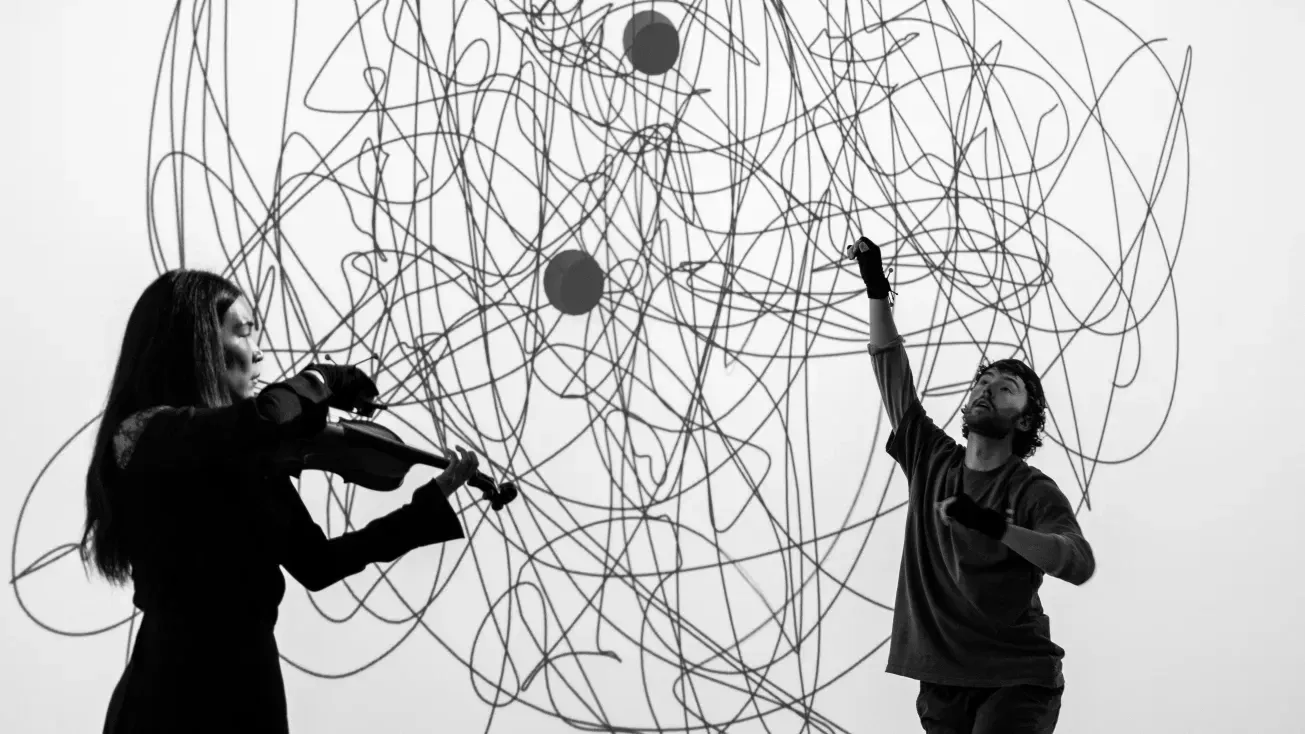
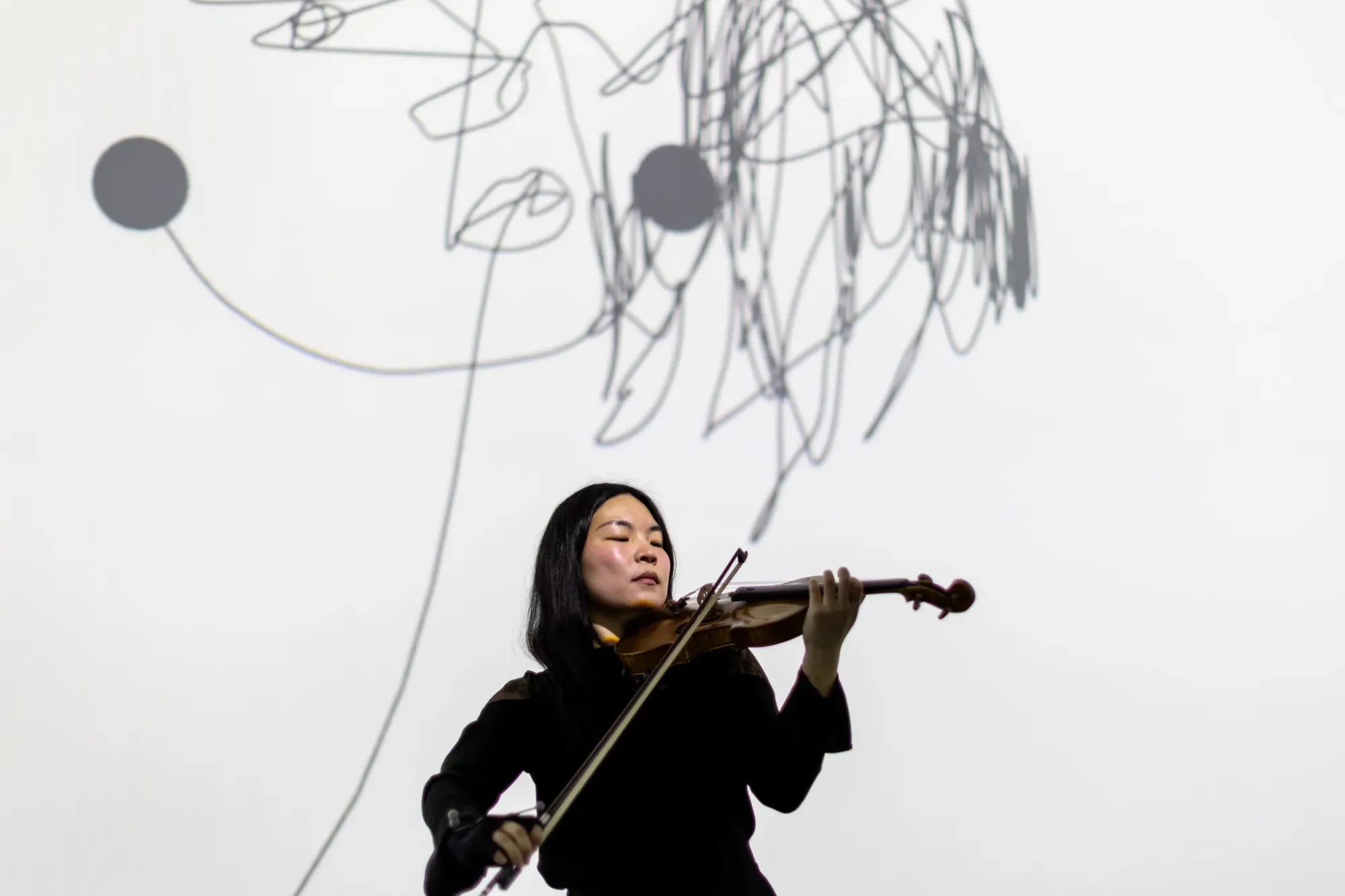
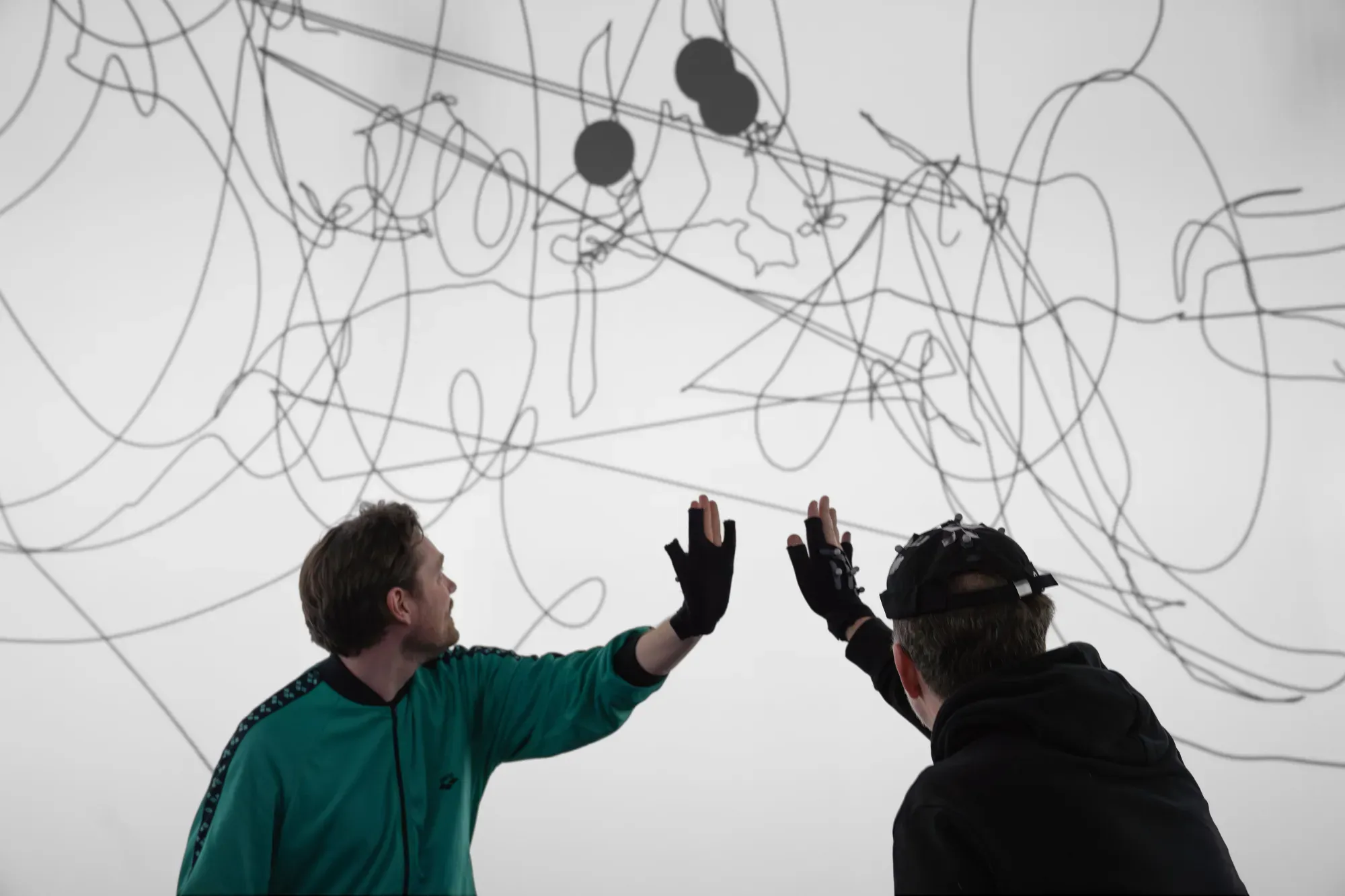
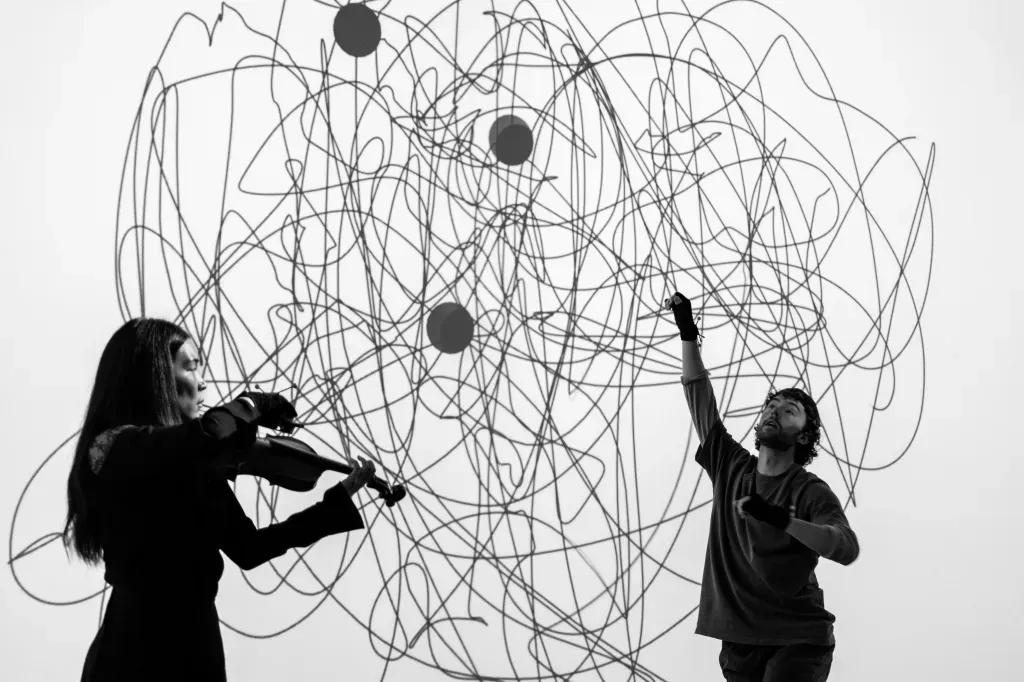
Drawing Lines begins with Sue In Kang walking onto a white stage and starting to play the violin. Two dancers join her in the space, moving to the music. “As if by magic, technology starts to create a visual response of her sound and movement in space”, choreographer, Giacomo Pini describes. What might seem like magic is actually AI, acting as a fourth performer and using motion tracking technology to follow the dancers’ movements, reacting and interacting as the performance develops. The visuals projected on the walls track and react to the dancers’ movements, who are in turn reacting to the music and the visuals. Drawing Lines acts as a conversation between the moving body, sound, and technology.
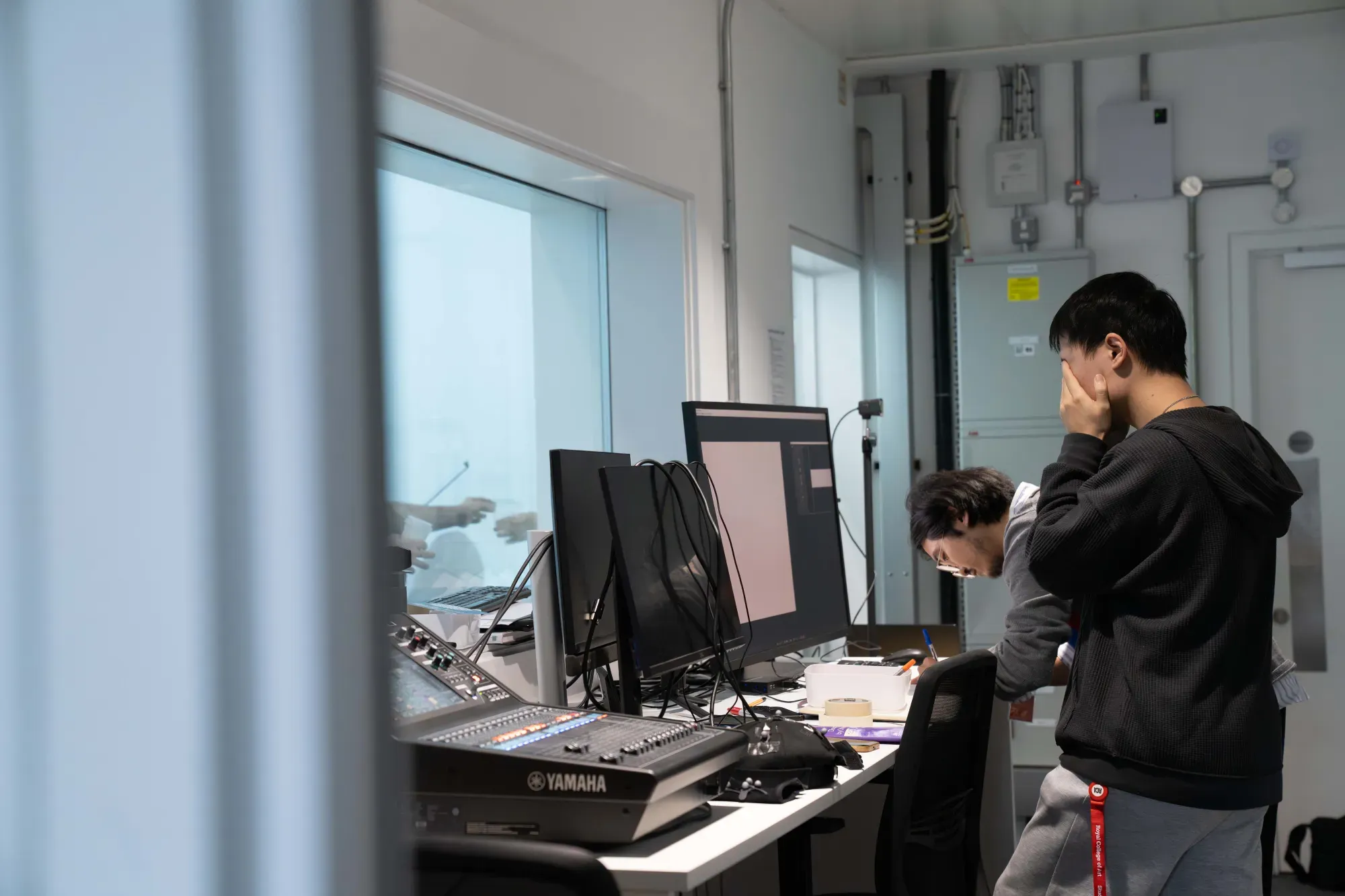
Having previously worked together on a project performed at Trinity Laban, Dr Freddie Hong, Sue In Kang and Giacomo Pini came together once again in Autumn 2025 to develop the ideas that would become Drawing Lines. They brought on board Dr Ali Mohammed and creative technologists Alex Xi and Rìan Stephens. The project was supported by the Royal College of Art’s VisLab Fund. The project held collaboration at its core explains Giacomo “The collaboration was in stages, working across the different elements of the performance. The dancers and I developed the choreography through improvisation with the creative technologies employed in the show and the unique setting of the VisLab, where the performances took place. My job as a choreographer was to devise creative tasks, observe carefully and then select and edit to create a dramaturgically coherent journey for the piece. Malachi and Amanda had not met prior to the project, but they seemed to click instantly, and they collaborated with myself and the rest of the creative team, demonstrating professionalism and skill.”
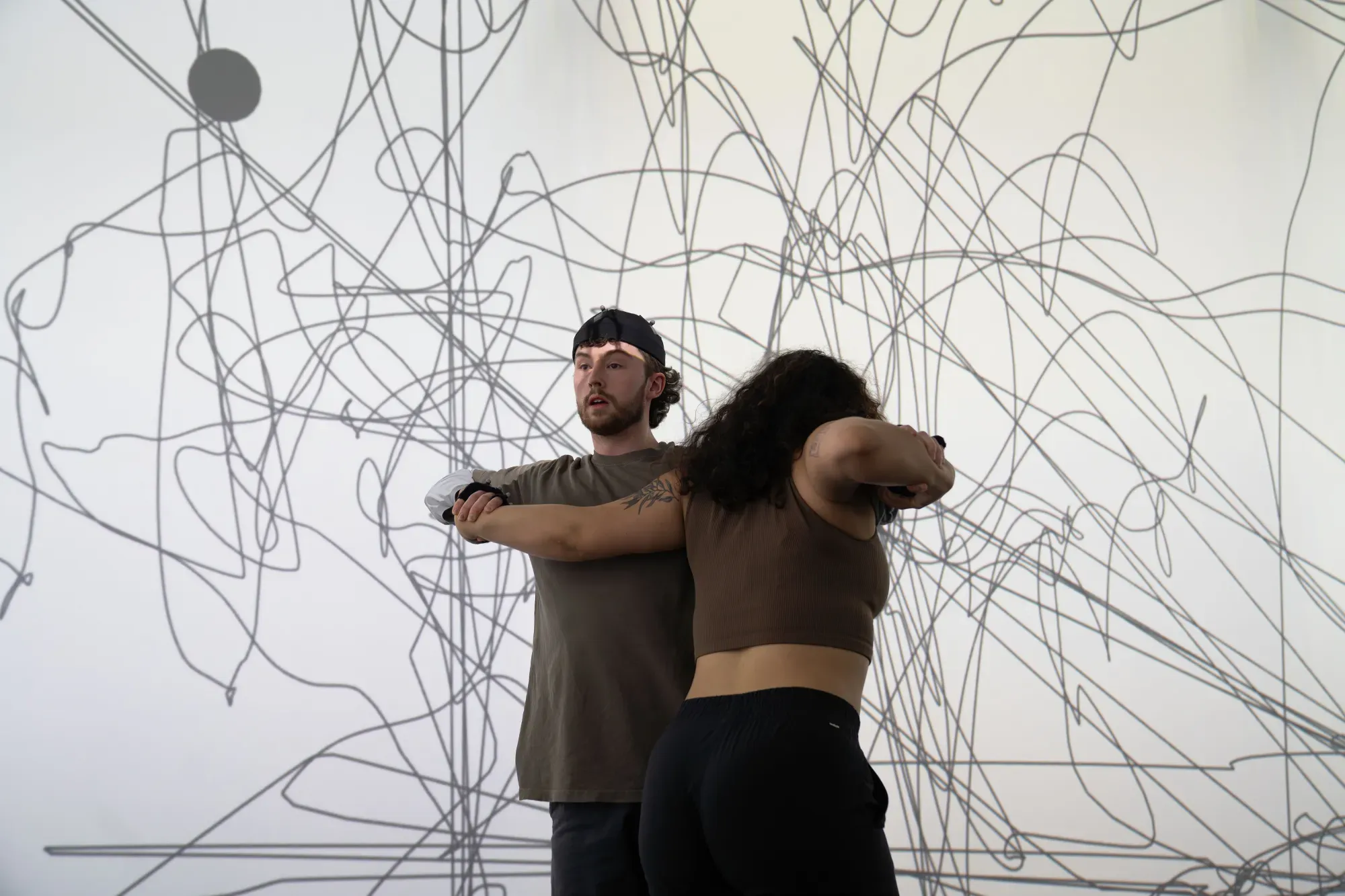
Technology was a central theme, with dancers wearing motion sensors which were picked up by the AI and translated into a visual accompaniment to the piece. Giacomo commented on the implications of using AI in this way “we reflected on the physical and psychological impact of technology in our lives and the ethical issues raised by the use of the latest creative technologies in the process of making art, and how this may influence both the performers’ and the audience’s experience.”
The use of AI was not without challenges, as Malachi explained “I remember during the first rehearsal when I tried dancing with the motion capture and projection, it made me move in quite a ‘linear’ way. The placement of the trackers on my head and hands, how sensitive they were in relation to the projection and movement, and what the projection looked like all played massive parts in shaping the choreography and improvisation. I like to be upside down during a performance, but the tracking technology isn’t such a fan of that and so it really challenged my habits and tendencies as a dancer. Every movement felt a lot more external as I had to keep the trackers somewhat separate in order for them to work and not confuse the sensors.”
It was often a matter of shifting perspective about who held the creative responsibility: sometimes, performers responded to what the technology was creating, whilst at other times AI was collecting information from the performers’ inputs
Giacomo describes AI not as simply an inanimate tool but as a “creative collaborator” which responded to both the music and dance being performed on stage “It was often a matter of shifting perspective about who held the creative responsibility: sometimes, performers responded to what the technology was creating, whilst at other times AI was collecting information from the performers’ inputs, such as movement or sound, and creating a visual or sound response.” Amanda expands, explaining how the intersection of dance and technology affected her performance “technology was the driving force – I am certain the movement would have been diametrically different if we were not considering the sensors, but it made me find new movement patterns and pathways. The AI provided a sense of structure to the movement creation, and it felt more like a conversation between the performers and the technology.”
Amanda describes the experience of performing Drawing Lines “The piece developed very organically; the movement was created in tandem with the sensors and sprung largely from necessity and practicality[…] the main focus was making sure the movement could be picked up by the technology whilst still finding freedom in movement.”
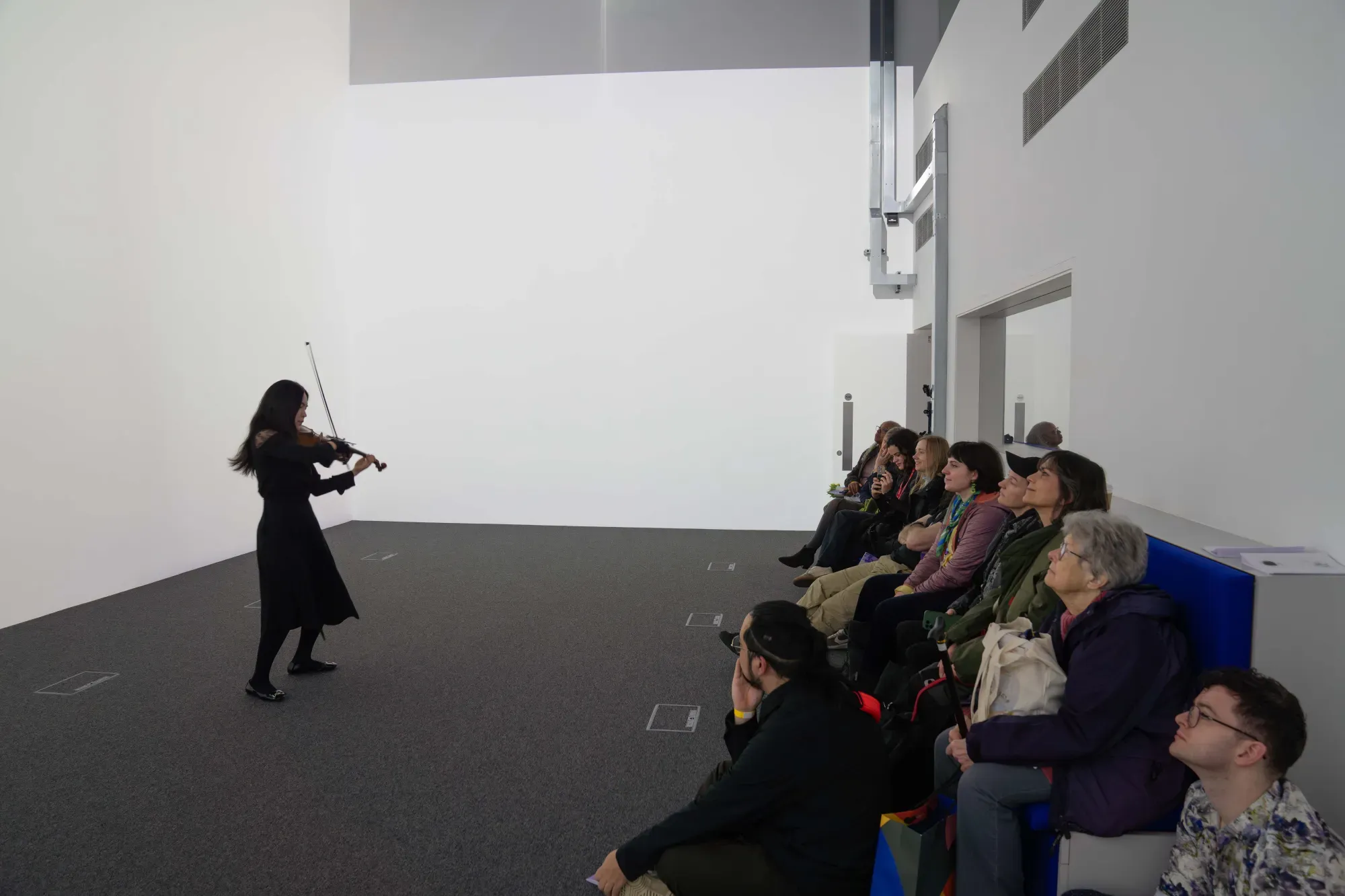
The project was based on collaboration between dancers, musicians, AI and, as Malachi explains, the audience “I had a lot of beautiful conversations about what I’m responding to and where I’m finding the inspiration […] I remember during one of the first performances, there’s a part where I jump towards the audience and it wasn’t meant to be intentionally scary or make you jump but an audience member did. I thought this was quite fun, so with each next performance I’d try to make the audience jump and even started to do a double take after the initial shock. It’s interesting when you start performing for an audience and how they mould and shape the work, where they give you energy, where you have to work a little harder sometimes to retain their concentration.”
As the first run of Drawing Lines comes to an end, Giacomo looks to take the piece further afield to international audiences, “We would love to bring it to more unconventional spaces and, personally, I would love for young people to see it because it is so much fun! We want the show to become even more inclusive, accessible and inspiring for all audiences, especially those who may be seeing contemporary dance for the first time.”
Through music, movement and AI, Drawing Lines offers a window into how creative collaboration might look in an increasingly technological world.
Giacomo Pini (Choreographer)
Giacomo (he/they) is a Queer, British-Italian, non-binary Dance Artist and Academic based in London. As a freelance performer, Giacomo has been working professionally for over a decade, collaborating with choreographers such as Amina Khayyam, Dora Frankel, Eliot Smith, Dam Van Huyn, Hannes Langolf, Mathieu Geffré and Shobana Jeyasingh. As a choreographer, they have created a wide range of dance performances for stage, unconventional spaces and camera, focusing on multi-disciplinary collaborations and touring internationally. Alongside his creative career, Giacomo is a Lecturer at Trinity Laban, specialising in Contemporary technique, Improvisation, Choreography and Yoga for dancers.
Malachi Briant (Performer)
Malachi started dancing at the age of 13 at his local ballet school in Cumbria. In 2019, he moved to London to train in contemporary dance at Trinity Laban, graduating with a First Class Honours Degree. Since graduating, Malachi has worked with companies such as Justice in Motion, Thickskin Theatre, BarrowFull, The Knotted Project and Pelican Theatre. He has performed in operas directed by Sir Peter Hall CBE, Sir David Pountney CBE, and Michael Grandage, as well as working with choreographers like Giacomo Pini, Gareth Mole, and Osian Meillir. Malachi has also worked internationally in Sweden, Ireland and Spain. In his spare time, he enjoys reading, cooking and making coffee.
Amanda Monteith (Performer)
Amanda currently lives and works between Houston, Texas and London, England, where she has attained her MA in Dance Performance at Trinity Laban. Her passion for dancing and performing has only grown and blazed brighter, having performed with notable choreographers such as Giacomo Pini, Bethany Logan Lofton, Sung Im Her, Kasia Witek, and Kayla Collymore. Her dancing has been featured in several productions including Her Brown Body is Glory, a capstone show for Arizona choreographer Hannah Victoria, Heather Waldon’s original work 18:30, and within the structure of Garage 713 Studios and performance team. Amanda self-produced her most recent work, BRUTE: a two-part dance work featuring live performance and film exploring brutalist concepts within a movement context.
Photo credit: Vivaan Thongram