MSc/MFA Dance Science
Course details
Introduction
Trinity Laban launched the world’s first Masters degree in Dance Science in 2001 and has been a pioneering force in the field ever since. Come and join a collaborative global community and find your place in the rapidly expanding field of Dance Science.
MSc Dance Science is a research-focused course, where you’ll use scientific approaches to understand and investigate dancers and dance practice across recreational, training and professional settings. Studying MFA Dance Science, you’ll be immersed in a 2-year research-focused postgraduate course, broadening the possibilities of dance science research and study. The diversity of experience and backgrounds of both students and faculty makes it a thriving and organic learning environment.
You’ll explore topics ranging from physiology, biomechanics, psychology and nutrition, and engage with scientific and creative modes of research. You’ll bring relevant experience in dance – whether as a dancer, choreographer, scientist, teacher, lecturer or health practitioner – and a strong motivation to deepen your knowledge of dance science.
Studying Dance Science at Trinity Laban will develop your applied research skills and give you the opportunity to conduct research in studio and lab-based contexts. It is also a collaborative programme, and you’ll have opportunities to work with students on other postgraduate programmes.
The Masters in Dance Science is a one-year (full time) or two-year (part time) course. On the MFA Dance Science, your first-year shares module content with students on MSc Dance Science, whilst an extended independent project forms your second year, giving you the opportunity to direct your learning through extended research. The blended-learning programme offers students a flexible and autonomous learning environment, integrating both online and in-person learning.
Key Features
This course is designed to assist professionals, practitioners and graduates from both dance or science related areas to investigate the intersections between science and dance. We tailor teaching to your specific interests and career goals to enhance your understanding, application, and dissemination of dance science research in the context of dance practice and performance.
Our Dance Science team is internationally known in the field and work with professional companies and organisations around the world. Trinity Laban is a founding partner of the National Institute of Dance Medicine and Science (NIDMS) and a supporter of the International Association for Dance Medicine & Science (IADMS).
MSc/MFA Dance Science at Trinity Laban is likely to appeal to you if you want to pursue a career in higher education, especially where a terminal degree is required. Our graduates go on to become consultants for dance companies, training institutions and national dance organisations. Some pursue further study at PhD level. Others use their dance science knowledge to inform their practice as dancers, teachers, rehearsal directors or choreographers.
Our team is internationally known in the field and work with professional companies and organisations around the world. Trinity Laban is a founding partner of the National Institute of Dance Medicine and Science (NIDMS) and a supporter of the International Association for Dance Medicine & Science (IADMS).
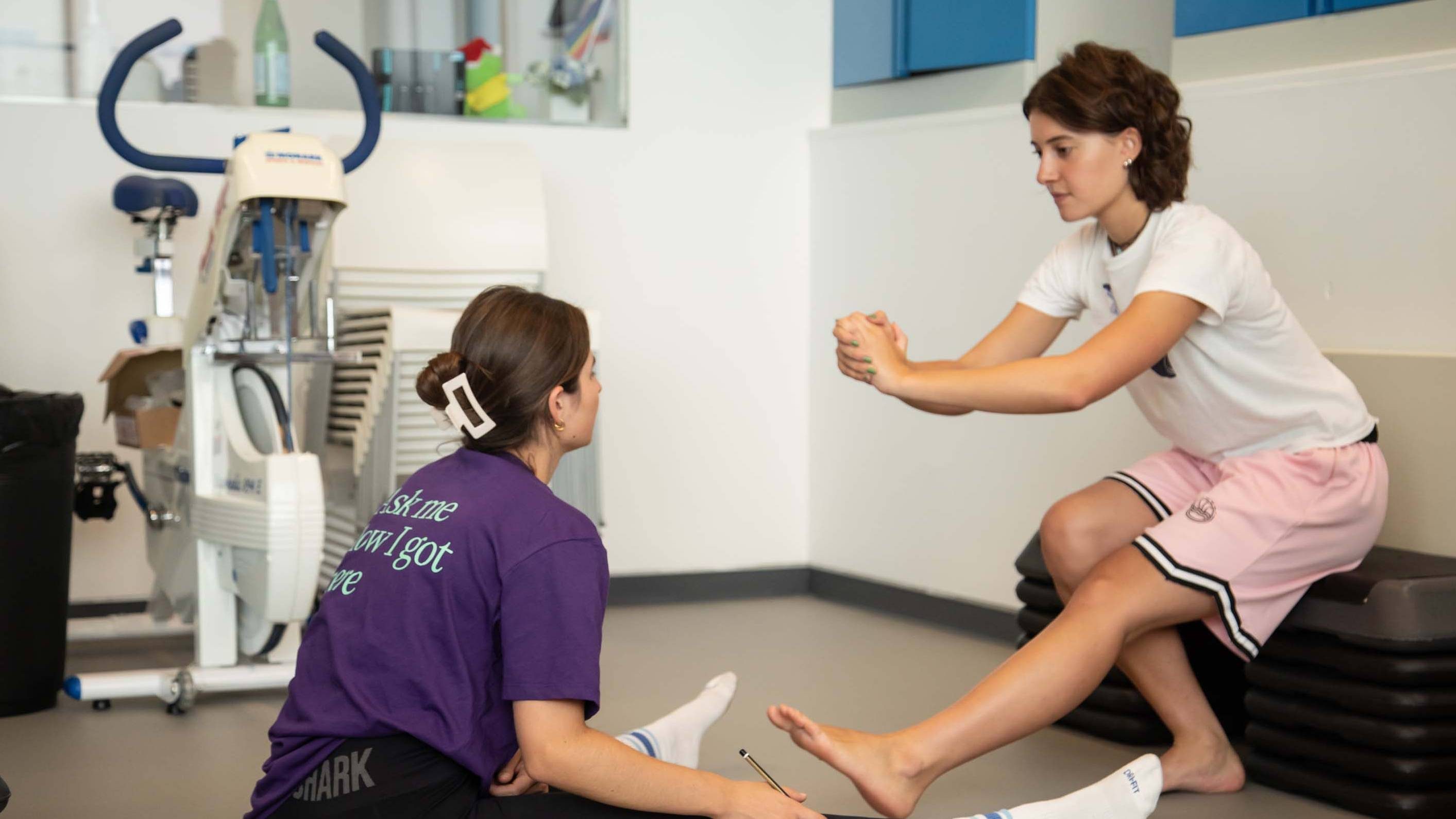
Our in-house Fitness Screening & Health Tracking Programme and departmental research projects give you the opportunity to gain valuable experience of working as a dance scientist while you study. Our specialist facilities include a versatile testing laboratory with dedicated support staff, a specialist dance library and 12 dance studios.
The MSc/MFA in Dance Science will set you up for various career pathways. The course provides a strong foundation for students who want to pursue a career in higher education, such as lecturers, researchers, or doctoral studies in dance science. Trinity Laban graduates have also gone on to work as consultants for dance companies, training institutions and dance organisations; while others have used the dance science knowledge and skills gained to enhance their practice in the field, as dancers, teachers, rehearsal directors, choreographers, clinical practitioners, fitness instructors, or business owners.
This programme is undergoing a periodic revalidation in 2025-26. Any subsequent updates to the programme curriculum and structure will be published in spring 2026 and all applicants will be notified.
Key Facts
- UCAS
- MSc 801F (Full-time), 804P (Part-time) / MFA 500M (Full-time)
- Duration
- MSc 1 year (Full-time), 2 years (Part-time) / MFA 2 years (Full-time)
- Location
- Laban Building
- Start Date
- September
Fees
Audition fees
Please note that there is no audition fee for this course. You will only need to pay the UCAS Conservatoires administration fee of £28.95 for the 2026 entry cycle.
2025-26
- Info 25/26
- Fees represent 2025/26 year only, programmes with more than one year are subject to fee increases after the first year
- MFA Dance Science (Full-time)
- Home £6,350 International £14,320
- Msc Dance Science (Full-time)
- Home £10,950 International £23,200
- Msc Dance Science (Part-time)
- Home £6,160 International £13,040
2026-27
- Info 26/27
- Fees represent 2026/27 year only, programmes with more than one year are subject to fee increases after the first year.
- MFA Dance Science (Full-time)
- Home £13,460 International £30,380
- MFA Dance Science Year 1 (Full-time)
- Home £6,600 International £14,890
- MFA Dance Science Year 2 (Full-time)
- Home £6,860 International £15,490
- MSc Dance Science (Full-time)
- Home £11,390 International £24,130
- MSc Dance Science Year 1 (Part-time)
- Home £6,410 International £13,560
- MSc Dance Science Year 2 (Part-time)
- Home £6,670 International £14,100
Key Dates
-
Applications open on UCAS Conservatoires
-
On-time application deadline on UCAS Conservatoires. Applications will be considered after this date.
-
Deadline for applying for a financial award (you should have submitted an application on UCAS Conservatoires and Embark prior to this). You may be considered for financial awards after this date, but funds will be limited.
-
Open Day
Plan your visit -
Welcome Week
See institutional term dates
Detailed Information
You’ll engage with qualitative, quantitative, and mixed modes of research, preparing you to translate theory and skills to practice. You’ll experience a variety of flexible learning and teaching methods, including webinars, seminars, digital and practical workshops, group and individual tutorials, mini-conference days, studio-and lab-based application, as well as independent and self-directed work.
Modules on the course cover Foundations in Performance Science, Approaches to Performance Research, and Performing Research 1 & 2, where you will get hands-on experience conducting research with performing artists in the laboratory and the studio.
To dive deeper into personal areas of interest, the Applications in Dance Science provides a selection of choices: Movement & Technique Analysis, Strength & Conditioning in Dance, Performance Psychology, Dance Training & Education, and Arts & Health.
During your studies, assessments are specifically designed with your employability skills in mind, aiming to reflect the knowledge and skills required of graduates entering the dance science sector. These tasks include a multidisciplinary dance science portfolio, developing a project proposal, group project lab reports and designing and delivering a Dance Science workshop.
The MSc Dance Science consists of approximately 1800 notional learning hours.
The MFA Dance Science consists of approximately 2600 notional learning hours.
Entry Requirements
To study with us you’ll need:
Normally a UK undergraduate degree in an appropriate or related subject, or an overseas award of equivalent standard.
Applicants without formal qualification, who may have the appropriate levels of professional experience are invited to complete Trinity Laban’s recognition of prior learning (RPL) process.
English Language requirements (if applicable):
• You will need IELTS Band 6.5 overall with a minimum of 5.5 in all four areas (Academic Test) or above (or equivalents). For more information, visit our English language requirements page.
• If you require a Student visa to study in the UK, please be aware of its English language requirements, as they may differ. Secure English Language Tests and levels can be found at gov.uk. Meeting external requirements of UK Visas and Immigration is essential.
MFA Applicants:
You will be required to submit an initial project proposal, in addition to your application, outlining the following:
• The reasons you wish to carry out an independent project over one academic year.
• Why you are suitable for extended independent research
• What your intended research might look like and a draft projected timeline with indicated outputs of research (which may be subject to change).
Who is this course for?
These courses are designed to assist professionals, practitioners and graduates from both dance or science related areas, to investigate the intersections between science and dance.
We welcome applicants from all backgrounds and we particularly encourage applications from different underrepresented groups.
How to Apply
First, you’ll need to submit your application on UCAS Conservatoires.
14 Jan 2026 – Postgraduate on-time deadline to submit both a UCAS Conservatoire application and Embark materials. We will accept applications after this date, but would recommend aiming for this deadline if you would like to be considered for a financial award.
20 April 2026 – Postgraduate Spring submission date. If you apply on UCAS Conservatoires and submit your Embark materials by this date, you will still be considered for financial support but there will be less chance of success.
Once you’ve submitted your application, you should complete the Dance Science Writing Supplement, which includes a Personal Statement and Academic Writing.
For applicants applying to more than one programme on UCAS, you may use the Personal Statement in the Writing Supplement to expand on your interest in Dance Science specifically.
Download this Supplement here.
You can contact us at admissions@trinitylaban.ac.uk for more information.
Staff
Teaching Staff

Dr Catherine Haber
Programme Leader MSc and MFA Dance Science


Dr Lucía Piquero Álvarez
Lecturer (Psychology), Module Lleader, Component Lead Teacher, and Project Supervisor


Scott Sinclair
Lecturer (Physiology) and Dance Science Senior Lab Technician

Michael Doolan
Dance Science Lab Technician

Sonia Rafferty
Lecturer (Dance Training & Education), Programme Leader BSc Dance Science

Dr James Brouner
Lecturer (Biomechanics)

Jasmine Challis
Lecturer (Nutrition)

Khyle Eccles
Lecturer (Strength & Conditioning)

Stella Howard
Lecturer (Arts & Health)
How to Apply – Dance
How to Apply
Take your next step
Fees & Your Finances
Explore your options
Audition information
Your guide